
Spokane County Superior Court Overview
Washington runs 39 Superior Courts, and the Spokane County Superior Court is one of them. It is a court of general jurisdiction, which means it can hear almost any kind of case. Felony criminal trials, divorce and family law, probate and guardianship, juvenile matters, civil commitment, paternity, adoption, and major civil disputes all belong here. The court also hears appeals from the District Court and from municipal courts in the county.
The court has 13 judges, each elected to a four-year term, plus eight court commissioners appointed by the judges. A Presiding Judge supervises court business and assigns cases to the trial departments. The county Superior Court page lays out these roles, and the Washington Courts directory keeps the current judge roster.
The state directory lists the court's judges, address, and direct phone lines.
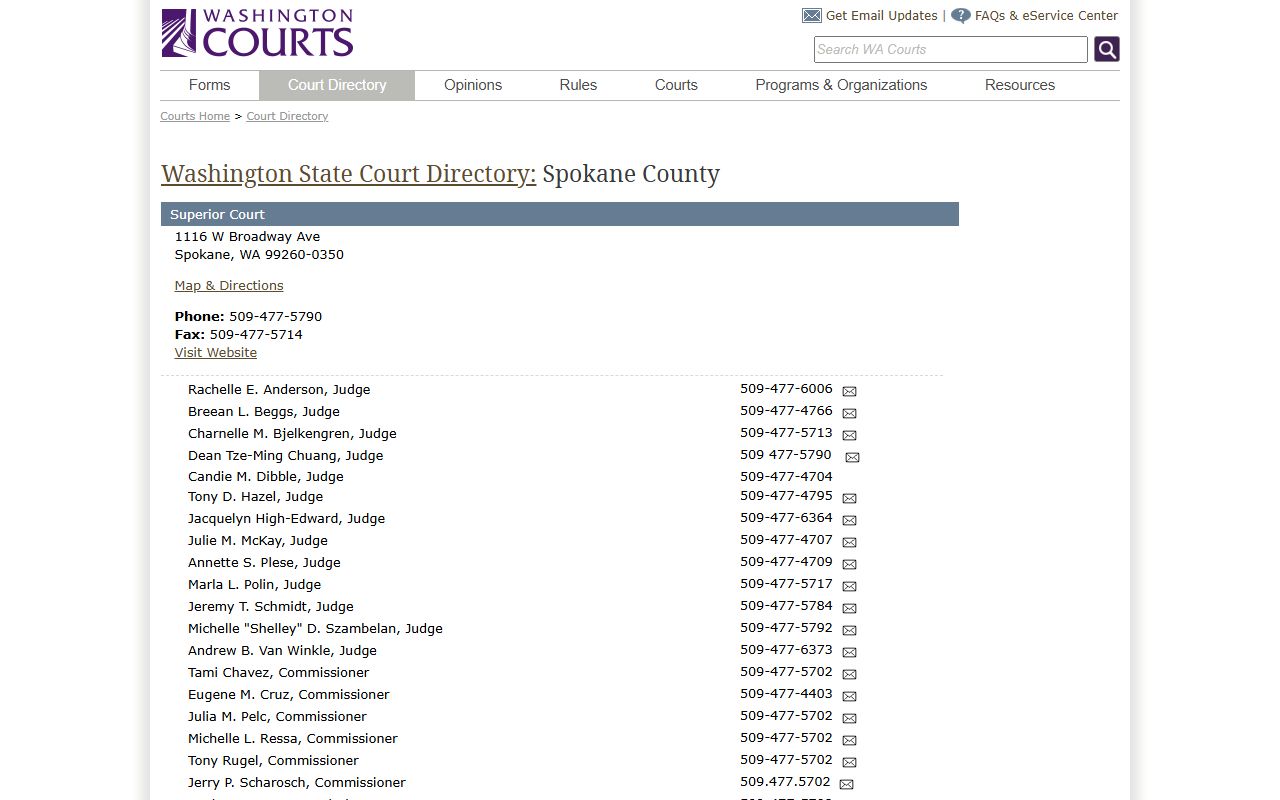
That directory is the best source for a full, current list of Superior Court judges and their staff contacts.
How to Search Superior Court Records
Superior Court case records are searched through the free county Court Viewer. You can run a search three ways: by case number, by party name, or by hearing date. A name search needs at least a last name and a first initial, and the full first name cuts down on same-name matches. Superior Court case numbers use a numeric format. The steps below cover a basic search.
- Open the county Search Portal and choose Superior Court.
- Pick a search mode: case number, defendant name, or hearing date.
- Enter the case number, or a last name with a first initial.
- Open the case information, documents, and hearings panels.
- Ask the Clerk for a certified copy when you need an official record.
Documents filed before January 2005 are not online and must be viewed in person or requested from the Clerk. Older files and copy fees are covered on the court records page.
Judges and Commissioners of the Superior Court
Each Superior Court judge works with a small team. A judicial assistant manages the calendar, a court reporter makes the verbatim record used for appeals, and a courtroom clerk keeps the journal of proceedings and handles exhibits. Beyond the trial judges, the court fills several leadership roles. The table sums up the main offices and what each one does.
| Role | What It Does |
|---|---|
| Presiding Judge | Supervises court business and assigns cases to trial departments under General Rule 29. |
| Chief Criminal Judge | Runs felony arraignments, motions, and pretrial conferences. |
| Therapeutic Courts Judge | Oversees Drug Court, Felony Mental Health Court, and the Co-Occurring Disorders docket. |
| Court Commissioners | Hear ex parte, domestic, juvenile, mental illness, and first-appearance matters; they do not run jury trials. |
There are eight commissioners in all. They take much of the daily calendar load so the elected judges can focus on trials and contested hearings.
Superior Court vs District Court vs Municipal Court
Spokane County has three trial-level courts, and each handles a different slice of cases. The Superior Court takes the general and serious work. The District Court takes limited matters. City courts handle code cases. The comparison below shows where each type of case lives.
| Superior Court | District Court | Municipal Court | |
|---|---|---|---|
| Jurisdiction | General | Limited | City code |
| Criminal | Felonies | Misdemeanors, gross misdemeanors | City ordinance crimes |
| Civil | Major civil, family, probate | Small claims, limited civil | City matters |
| Records search | County Court Viewer | County Court Viewer | Separate city site |
For a full breakdown of the District Court's work, see the Spokane County District Court page. City code cases are searched on the separate Spokane Municipal Court site.
How a Case Moves Through Superior Court
Most Superior Court cases follow a set path from filing to decision. A felony case starts after an arrest and charging, while a civil or family case starts with a petition. The two flows below show the common steps.
Criminal flow: Arrest › First Appearance › Information Filed › Arraignment › Pretrial › Trial › Sentencing › Appeal to Division III
Civil flow: Petition Filed › Response › Case Schedule › Discovery › Mediation › Trial › Judgment › Appeal
A felony arrest by the Sheriff's Office normally enters Superior Court for prosecution by the Prosecuting Attorney. The Criminal Court Commissioner hears the First Appearance docket, where conditions of release and bond are set.
Civil, Family, and Criminal Work
The Superior Court does not split into numbered departments the way some states do. Instead, the Presiding Judge assigns cases across the bench, and commissioners cover set calendars. Family and domestic matters, including divorce, custody, and support, make up a large share of the work. Probate, guardianship, and adoption add to the civil side.
Therapeutic dockets sit inside the criminal side of the court. Drug Court, Felony Mental Health Court, and the Co-Occurring Disorders docket give some felony defendants a treatment path instead of a standard sentence. These dockets are run by the Therapeutic Courts Judge.
The county campus map notes a Mental Health Therapeutic Court office in the Broadway Center Building, though those hearings are held in the Public Safety Building. So the office and the hearing room are in two different buildings, which is worth checking before a court date.
Records the Superior Court Holds
The Clerk of the Superior Court keeps the files for every Superior Court case. That covers a wide span of record types, and the Clerk acts as the court's judicial administrator. Many of these files are open to the public, but several categories are restricted by statute or court rule.
- Felony criminal cases and judgments.
- Divorce, custody, support, and parentage files.
- Probate, guardianship, and estate matters.
- Civil commitment and mental illness proceedings.
- Adoption and juvenile files, which are confidential.
The court also keeps courtroom journals, exhibits, and digital recordings of some proceedings. Restricted files, such as juvenile and adoption records, are closed under Washington statutes, and the Clerk can confirm whether a file is open before you order copies.
Appeals and the Court of Appeals
An appeal from Spokane County Superior Court goes to the Washington Court of Appeals, Division III, which is based in Spokane. From there, a party may ask the Washington Supreme Court to review the case, though the Supreme Court chooses which cases it takes. Appeals from the District Court and municipal courts can move up to the Superior Court first.
Note: Superior Court trial dates can change; the court asks people to confirm a date with Superior Court Administration before they rely on it.
Superior Court Courthouse and Contact
The Superior Court sits in the historic Spokane County Courthouse on the county campus north of the Spokane River. The Clerk of the Superior Court is in the same building, in Room 300. Bring a case number or party names when you visit, and confirm the right building before you go.
Spokane County Superior Court
1116 W Broadway Ave, 3rd Floor Annex
Spokane, WA 99260
509-477-5790
The Historic Superior Court Building
The Superior Court works inside one of the most striking county buildings in Washington. The county broke ground in the fall of 1893, during a national financial panic, and the project helped a struggling local economy. Officials moved in by November 20, 1895. The county calls the building a "castle," and its French Renaissance design draws from chateaux in France's Loire Valley.
The courthouse still anchors the county campus, even as court work has spread into annexes and the Public Safety Building. The official courthouse history covers the design and construction in detail. For visitors, the key point is simple: the Superior Court and the Clerk are in the historic courthouse, while many District Court calendars are a short walk away.