
Arrest Records in Spokane County
An arrest record is the trail left when someone is taken into custody. In Spokane County, most county arrests run through the Sheriff's Office and Detention Services, which book people into the county jail. City police, tribal police, and other agencies also make arrests, and each one shows as a report agency on the booking. The record ties a person to a booking number, an intake date, and the charges that brought them in. The county is led by Sheriff John Nowels, who took office in January 2023.
The image below is the Sheriff John Nowels page on the county site.
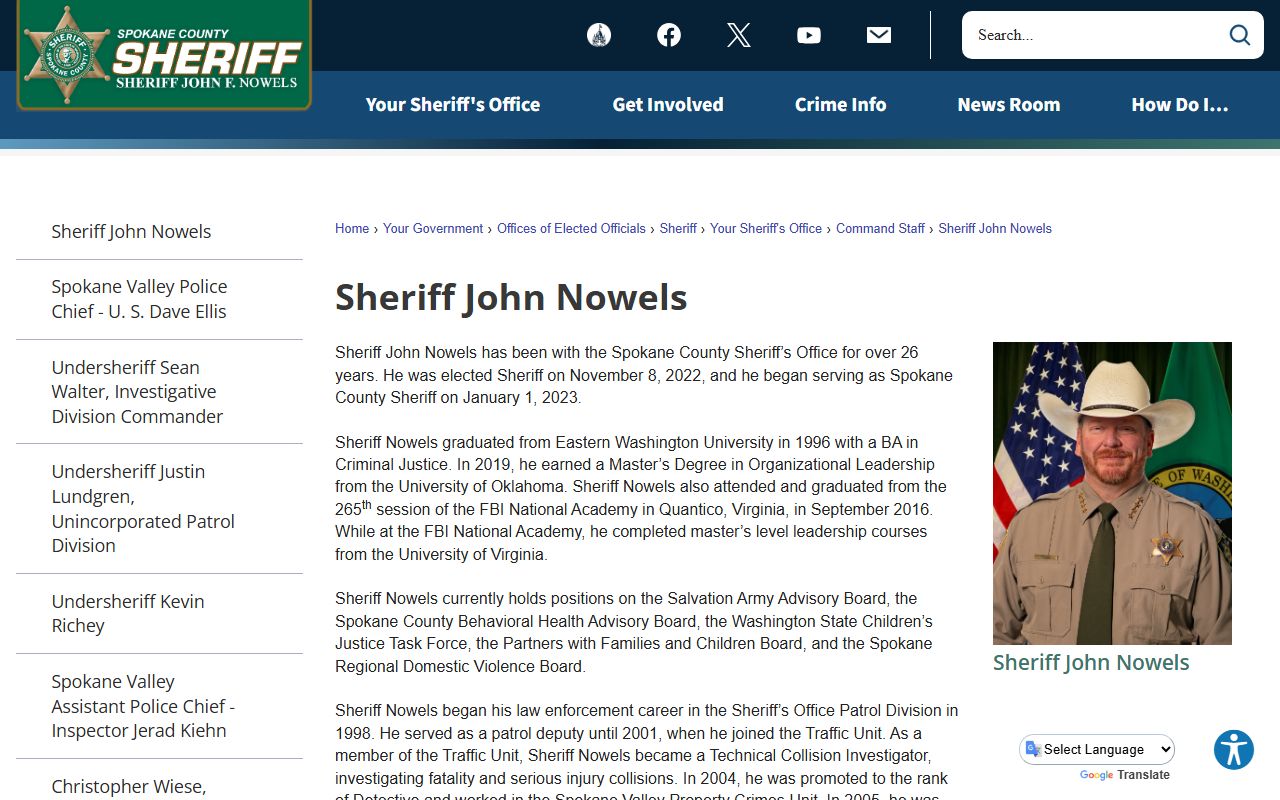
The Sheriff's Office runs the jail and the public roster that surfaces most recent county arrests.
An arrest record is not the same as a criminal court record, and neither one is a conviction. An arrest happens first, at booking. A criminal court record opens later, when a prosecutor files charges and the case lands in a courtroom. Full case files and outcomes are covered on the court records page; this page stays on the arrest and booking side. Treating these as one thing leads to wrong guesses about what a record means.
How to Search Spokane County Arrest Records
The fastest way to find a recent county arrest is the live Detention Services inmate roster. It has tabs for current inmates, recent bookings, and recent releases, plus A-Z filters by last name. A booking ties to charges, a report agency, and a bond. The roster is the public face of most county arrests, since a booking lands a person there right away. The county Search Portal links the roster next to the court searches.
- Open the inmate roster and choose Recent Bookings to see new arrests.
- Filter by the first letter of the last name to trim the list.
- Click a name to open the booking detail with charges and report agency.
- Note the booking number and case numbers for a later court search.
For the court side of an arrest, the county Court Viewer searches Superior and District Court cases by name or case number. A felony booking usually heads to Superior Court, while a misdemeanor may go to District Court.
The view below is the Superior Court criminal case-by-name search.
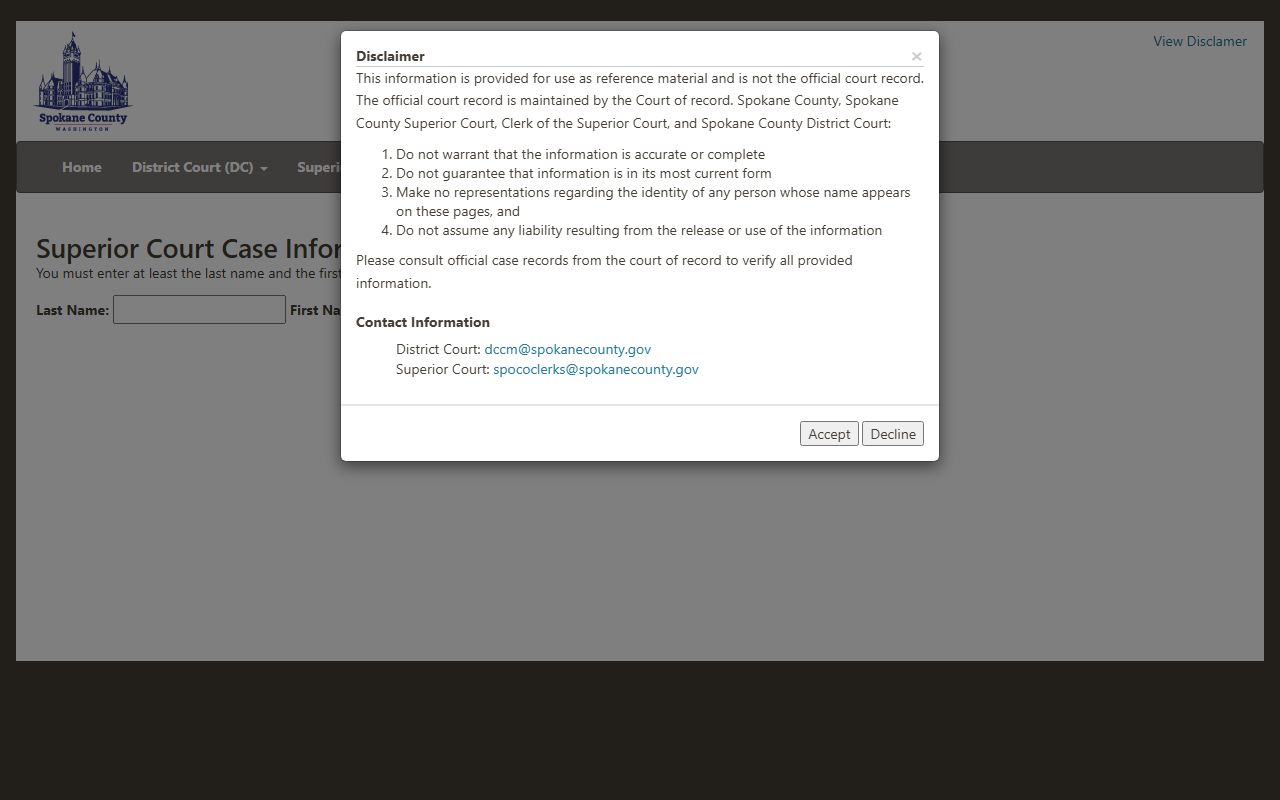
That search needs at least a last name and a first initial, and results list name, case number, and date of birth.
Arrest Records vs. Criminal Court Records
The two records come from different offices and start at different points. An arrest record is built at booking by law enforcement. A criminal court record is built by the court once charges are filed. One can exist without the other, since not every arrest leads to a filed charge.
| Arrest Record | Criminal Court Record | |
|---|---|---|
| Source | Sheriff or police | Court clerk |
| Created When | Booking into jail | Charges filed |
| Contents | Booking number, charges, report agency, bond | Pleadings, motions, judgment, sentence |
| Where to Find | Jail roster | County Court Viewer |
To follow a case from arrest to outcome, you may need both. Start with the roster for the booking, then move to the Court Viewer for the filed case. Full criminal records and dispositions live on the court records page.
The Spokane County Prosecuting Attorney
The Prosecuting Attorney decides what charges to file after a felony arrest. The office handles county criminal prosecution and has roughly 66 attorneys across its units. Its criminal department is split into divisions that match case types, so a violent crime and a drug case route to different teams.
- Major Crimes and Gangs.
- Special Assault.
- Domestic Violence.
- Drugs and Property.
- Felony Traffic.
- Juvenile and Misdemeanors.
An arrest does not become a court case until this office files a charging document. That gap is why a person can be booked yet never charged, or charged with something different from the booking charge.
The page below is the Spokane County Prosecuting Attorney office overview.
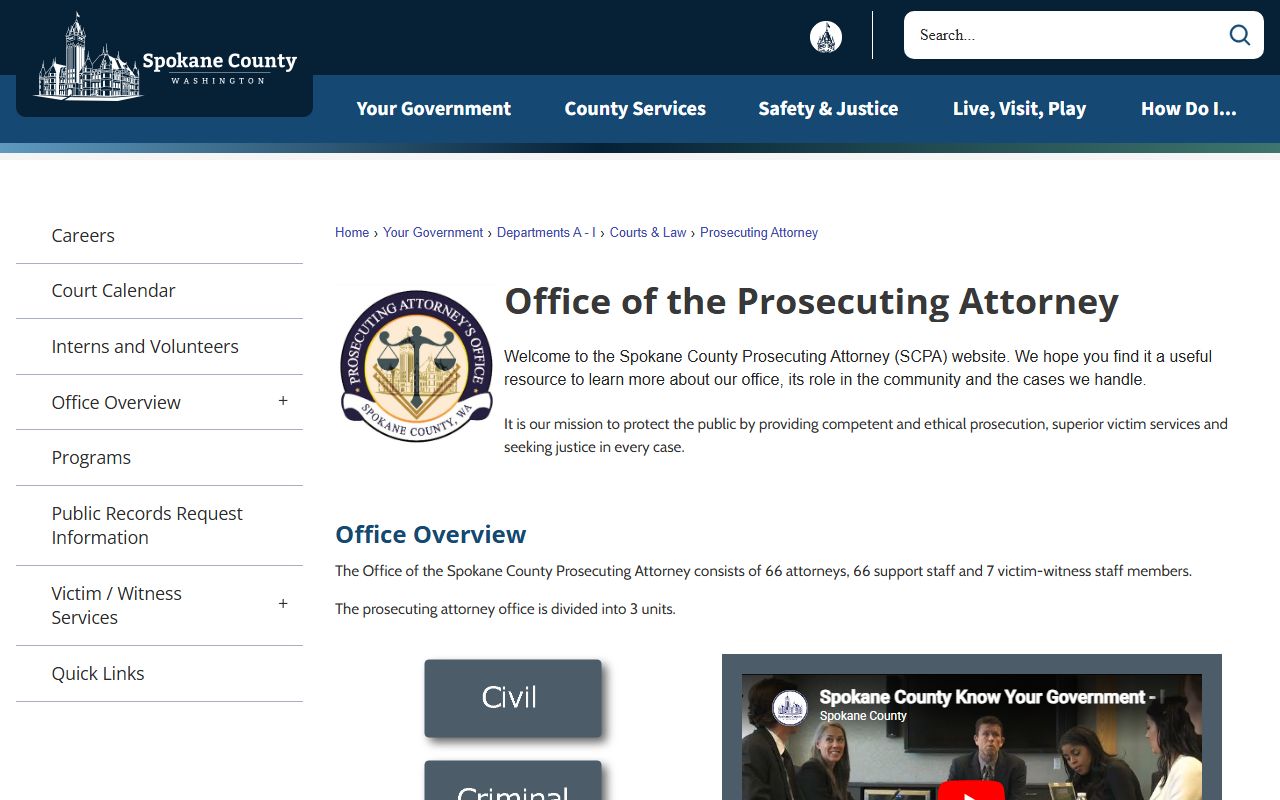
The office is at 1100 W Mallon Avenue, and its main line is 509-477-3662.
Charges vs. Convictions
Being charged is not the same as being convicted. A charge is an accusation. A conviction is the result, by guilty plea or by verdict. The standard of proof is far higher to convict than to charge.
| Charge | Conviction | |
|---|---|---|
| Stage | Accusation at filing | Plea or verdict |
| Burden of Proof | Probable cause | Beyond a reasonable doubt |
| Public Record | Yes, in most cases | Yes, in most cases |
| Final? | No, can be dropped | Yes, unless appealed or vacated |
A booking charge can change, get reduced, or get dropped before trial. Read an arrest record as a starting point, not a final answer. The case disposition in the court file tells the real outcome.
Mugshots and Booking Photos
Booking photos, often called mugshots, are taken at intake. In Spokane County, the public inmate detail page inspected did not display a mugshot in the record output, so booking photos are not always shown in the online roster. The roster focuses on name, booking number, charges, report agency, and bond.
Booking photos can be requested through the county public records process when they are releasable, since some images are limited by privacy and safety rules. A mugshot alone proves only that a person was booked, not that they were convicted. Many private mugshot sites repost old photos out of context, which is why the official roster and court file matter more than a stray image.
Note: A booking photo reflects one moment in custody and says nothing about guilt, charges that stuck, or the final case outcome.
Public Defender and Pretrial Services
People arrested and facing charges may qualify for appointed counsel. The Spokane County Public Defender represents eligible defendants in District and Superior Court criminal cases. Pretrial Services screens eligibility and helps people apply, often soon after booking or a first appearance.
The Public Defender office is at 1033 W Gardner and can be reached at 509-477-4246. Pretrial Services sits at 1116 W Broadway, 1st Floor Annex, phone 509-477-3960. A defendant generally applies for appointed counsel through the online application or in person.
The image below shows the Spokane County Public Defender page.
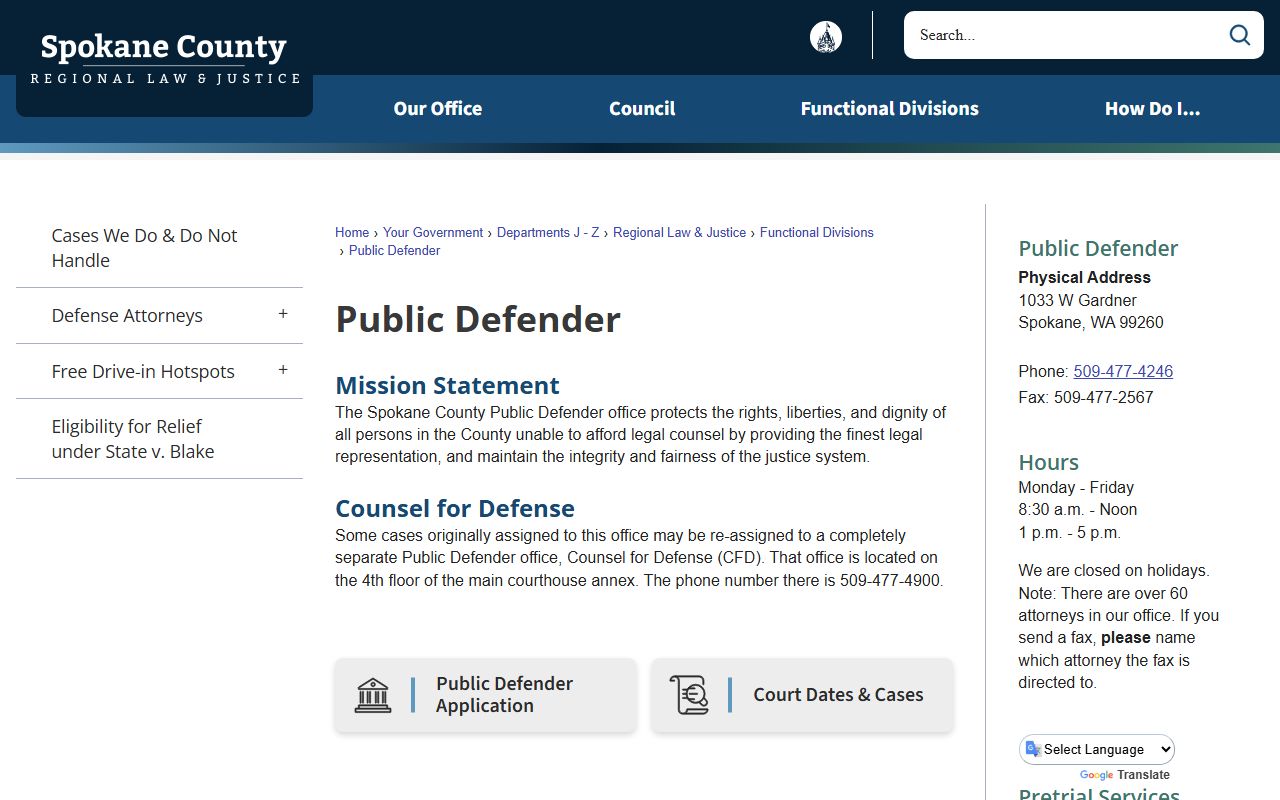
Appointed counsel can shape how an arrest turns into a charge, a plea, or a dismissal.
Public vs. Restricted Criminal Records
Most adult arrest and criminal case data is public, but several categories are closed by law. Juvenile records are restricted under Washington juvenile statutes, and the county does not post juvenile offender or dependency dates online. Sealed records are hidden from ordinary public view by court order. Vacated convictions change a person's legal status, which is covered further below.
Jail records carry extra limits. Spokane County cites RCW 70.48.100, which keeps jail records confidential beyond the public roster. Specific inmate information often needs a signed waiver from the inmate or a court order, plus valid ID. The dissemination of broader criminal history by criminal justice agencies is governed by the Washington Criminal Records Privacy Act.
- Juvenile and dependency records, limited by statute.
- Sealed records, closed by court order.
- Vacated convictions, with changed legal status.
- Detailed jail records beyond the public roster.
For warrant detail tied to an arrest, see the warrant records page.
Washington Criminal Records Privacy Act
Washington controls how criminal history record information moves between criminal justice agencies and the public. The Washington Criminal Records Privacy Act, Chapter 10.97 RCW, sets those rules. It separates conviction data from non-conviction data and limits how non-conviction information can be shared.
This act sits apart from court case access, which runs under court rules. An arrest that ends without a conviction is treated differently from one that leads to a guilty finding. The county Clerk explains how to get certified criminal court records by mail, with a fee per page.
The page below is the Clerk's Obtaining Criminal Court Records guidance.
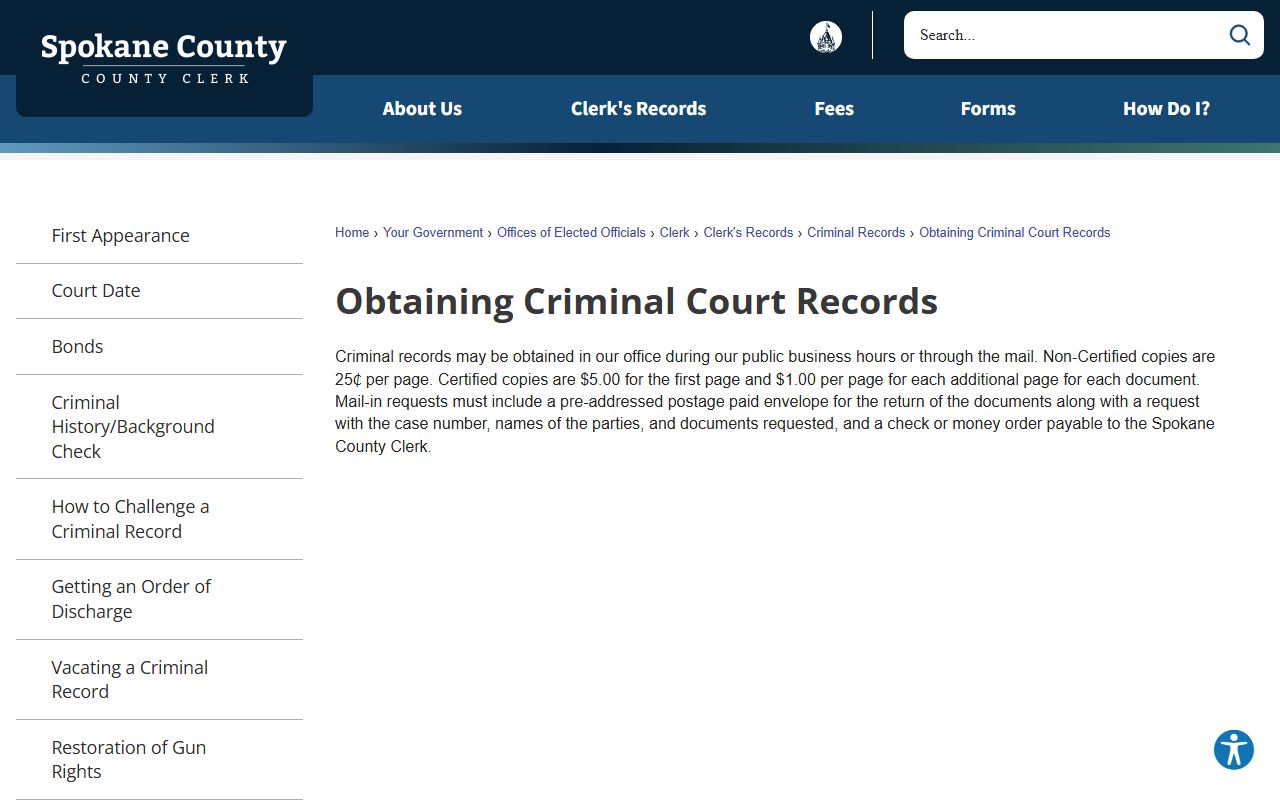
Certified copies run $5 for the first page and $1 for each added page, with non-certified copies at $0.25 per page.
Sealed vs. Vacated Records
Washington does not use the word expungement for adult convictions. It uses vacation. A sealed record is hidden from the public but still exists. A vacated conviction is set aside after a person meets statutory conditions, which changes the legal status of the conviction.
| Sealed | Vacated | |
|---|---|---|
| Effect | Hidden from public view | Conviction set aside by court order |
| Record Exists? | Yes, but closed | Yes, with changed status |
| Law Enforcement | Limited access | Status updated; not erased everywhere |
| Typical Path | Motion to seal | Motion to vacate in court of conviction |
Felony vacation runs under RCW 9.94A.640, while misdemeanor and gross misdemeanor vacation runs under RCW 9.96.060. Eligibility depends on the offense, time since discharge, paid obligations, and a clean record since. A person files a motion in the court of conviction and serves the prosecutor.
The page below is the official RCW 9.94A.640 felony vacation statute.
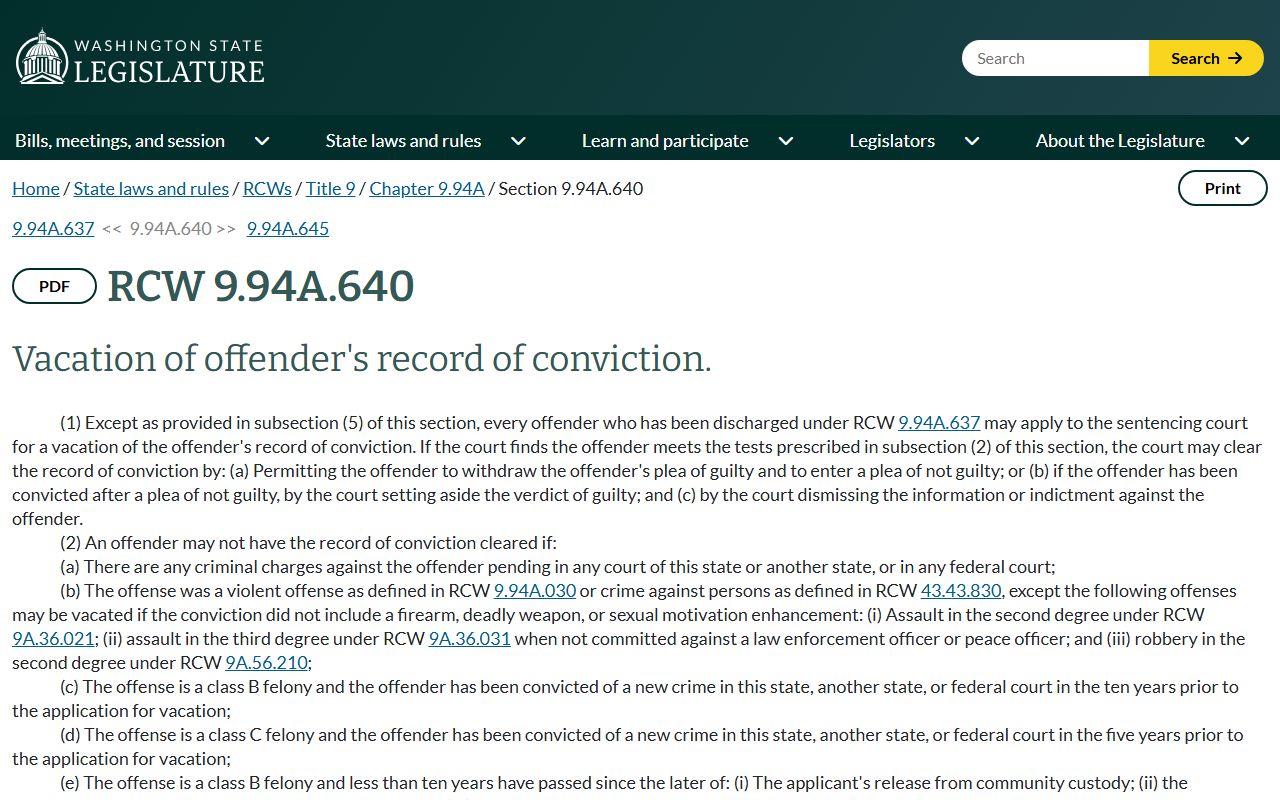
Vacation does not erase every reference from every source, and a person should expect the change to take effect through the court and state systems over time.
Background Check Considerations
A casual arrest-record lookup is not the same as a regulated background check. Formal checks for hiring, housing, or credit must follow the federal Fair Credit Reporting Act and use a licensed consumer reporting agency. The free roster and Court Viewer are for general public reference, not for those regulated uses.
Important: This site is not a consumer reporting agency under the FCRA, and its data may not be used for employment, tenant, credit, or insurance screening.