
How to Search Spokane County Court Records
The main tool is the Spokane County Court Viewer, a free public viewer for court dates and case information. It covers both the District Court and the Superior Court. You can also start at the county Search Portal, which links the viewer, the jail roster, and the statewide Washington Courts search in one place.
Before you start, decide which court holds the case and pick a search mode. Case number works best when you have it. A name needs at least a last name and a first initial. A hearing-date search finds a calendar rather than a full file.
The Court Viewer home page lists the District and Superior Court search menus side by side.
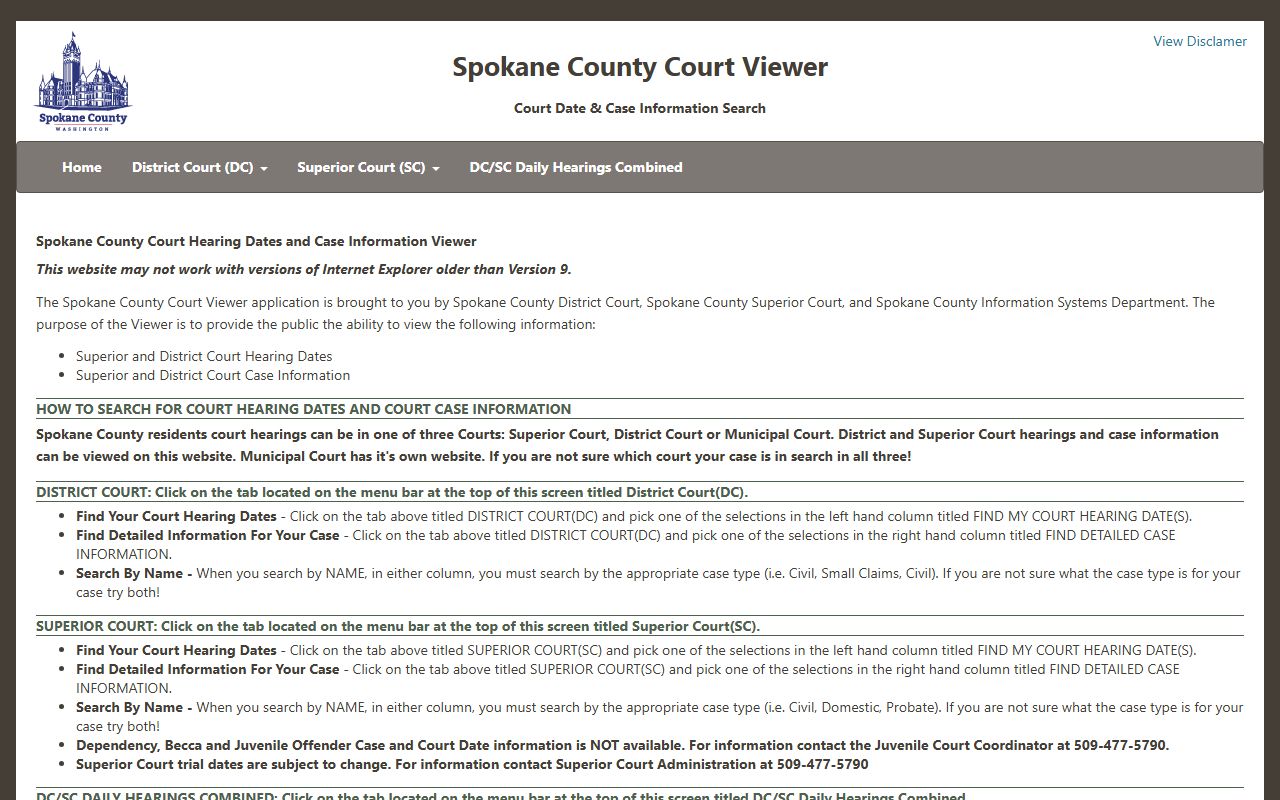
From that menu you choose the court, then the type of search you want to run.
- Open the Court Viewer and pick Superior Court or District Court.
- Choose case number, party name, or hearing date.
- Type the full case number, or a last name with a first initial.
- Review the case information, documents, and hearings panels.
- Request a certified copy from the clerk when you need an official record.
Treat everything the viewer returns as reference data. The county states the official record stays with the court of record, and it does not warrant that the viewer is accurate, complete, or current. It also makes no claim about the identity of any person whose name shows up. For questions, the viewer lists dccm@spokanecounty.gov for District Court and spococlerks@spokanecounty.gov for Superior Court.
One more split matters. City code cases are not in the county viewer. Spokane Municipal Court keeps its own separate site for those hearings and cases, so a city ticket may not turn up in a county search.
Spokane County Court Records Search Fields
Each search mode uses a small set of fields. A name search is the most common, and it works the same way in both courts. The county requires a last name and at least the first initial of the first name. Adding the full first name cuts down on same-name matches. The table lists the fields for a Superior Court search by defendant name.
| Field Label | Type | Required | Notes / Format |
|---|---|---|---|
| Last Name | Text | Yes | At least the full last name. |
| First Name | Text | Yes | First initial minimum; full name narrows results. |
| Case Number | Text | If known | Numeric for Superior Court, alphanumeric for District Court. |
| Hearing Date | Date | For calendar search | Find a hearing list for one date, with A-Z filters. |
| Search / GO | Button | Yes | Submits the query. |
A Superior Court case-number search returns the case information, documents, and hearing panels for that single file.
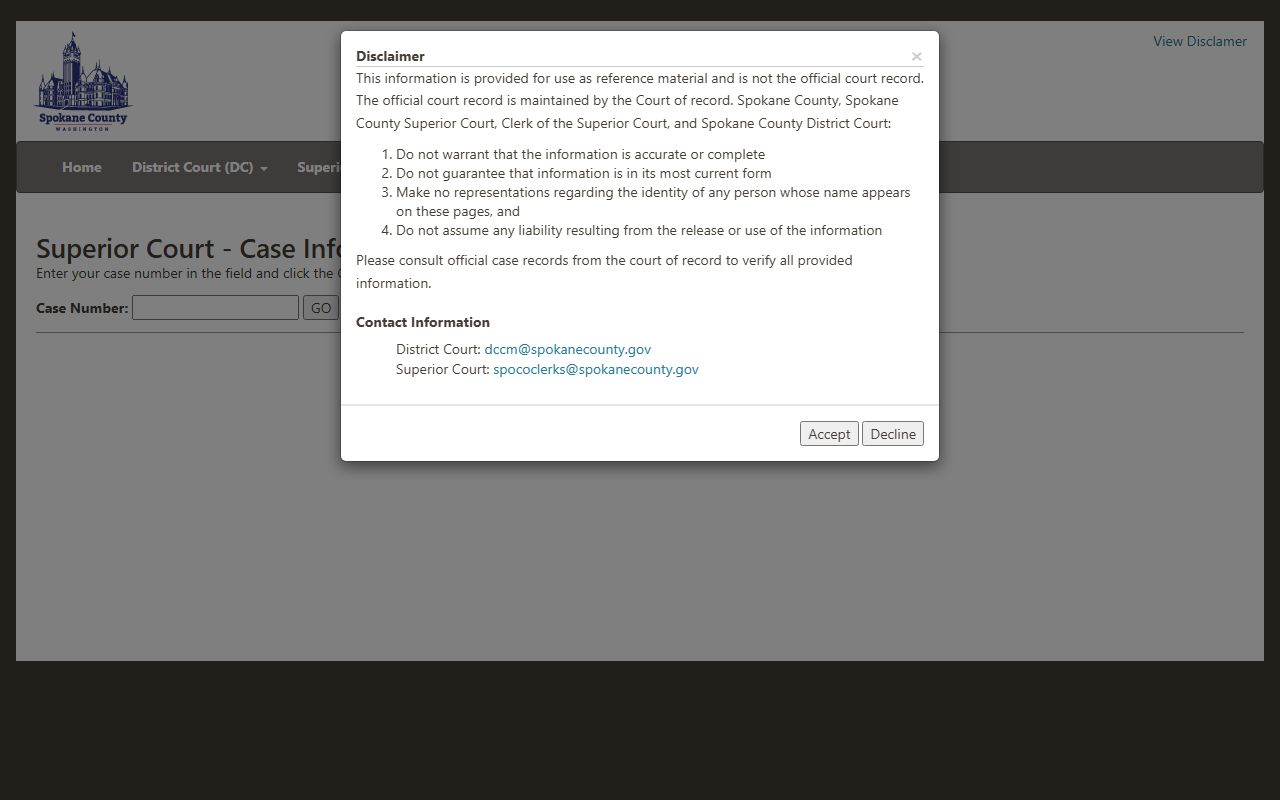
District Court searches use the same layout but accept the alphanumeric District Court case format.
Types of Spokane County Court Records
The court that hears a case keeps its records. Spokane County Superior Court holds general-jurisdiction files, and the District Court holds limited-jurisdiction files. That split decides where you search and who you ask for copies.
Superior Court records run from felony criminal files to divorce, probate, and big civil suits. District Court records cover the day-to-day volume of misdemeanors, tickets, and small disputes.
- Civil records, such as complaints, judgments, garnishments, and liens.
- Criminal records, with felonies in Superior Court and misdemeanors in District Court.
- Family records, including divorce, custody, support, and parentage.
- Probate records for estates, wills, and guardianships.
- Traffic and infraction records processed by the District Court.
The statewide Washington Judicial Information System ties many of these case types into one data set.
For arrest and booking detail, the arrest records page goes deeper into criminal files.
Superior Court vs District Court Records
The two trial courts hold different records, and that shapes where you look. The comparison below sums up the split so you can route a Spokane County court records search to the right court the first time.
| Feature | Superior Court | District Court |
|---|---|---|
| Jurisdiction | General | Limited |
| Criminal | Felonies | Misdemeanors, gross misdemeanors |
| Civil | Major civil, family, probate | Small claims, limited civil |
| Other | Guardianship, juvenile, adoption | Traffic, name changes, protection orders |
| Records held by | Clerk of the Superior Court | District Court Clerk |
Federal cases are a third track. Those go to the U.S. District Court for the Eastern District of Washington in Spokane and are searched through PACER, not the county viewer. Appeals from Superior Court move up to the Court of Appeals, Division III.
What Spokane County Court Records Show
A Court Viewer result is built from a few panels. The case information panel names the parties and the case status. The documents panel lists filings, though Superior Court documents from before January 2005 are not online. The hearings panel shows the calendar. The fields below appear in most case-number results.
| Field | What It Shows |
|---|---|
| Case Number | The court file number used to pull the record. |
| Filing Date | When the case opened. |
| Parties | Plaintiff, petitioner, defendant, or respondent. |
| Hearing Type / Date | Calendar, start time, and courtroom location. |
| Documents | List of filings, viewable as images when available. |
| Disposition | The outcome once the case is decided. |
When a document is open in the viewer, the page shows a case number, a sub number, a document ID, and a page count. The image below is the Superior Court document viewer.
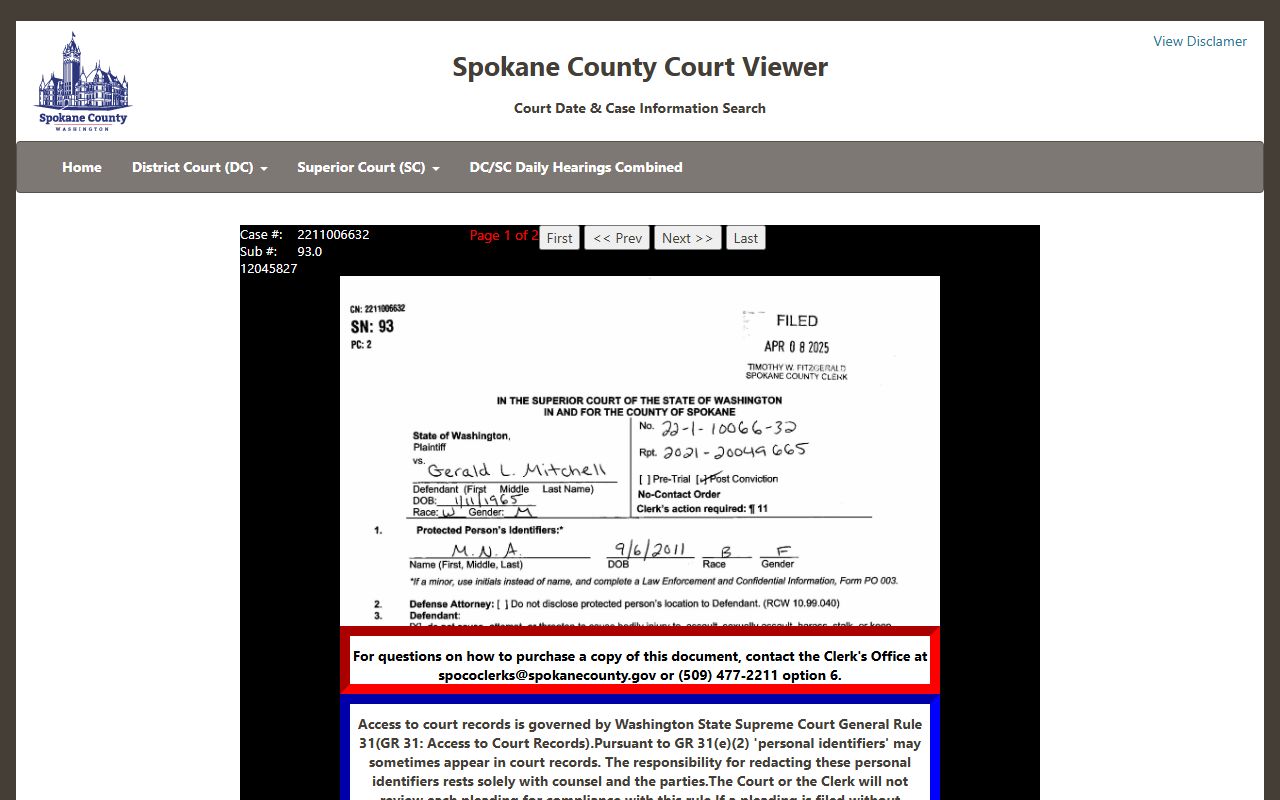
To buy a copy, the viewer points users to the Clerk's Office. Hearing details are broken out further on the court dockets page.
Public Access Framework for Spokane County Court Records
Washington keeps court case records under court rules, not the general Public Records Act. The Public Records Act, Chapter 42.56, covers county agency files, but case files run under General Rule 31. The county is clear that court records cannot be pulled through its online public records portal.
Anyone can search the open record. Certified copies carry a fee, and the clerk sets page counts before you pay. The Washington Courts data dissemination page explains statewide release rules for bulk court data.
Note: Court records come from the clerk or court administrator, not the county GovQA portal, which the county reserves for non-court agency records.
Records That Are Sealed or Confidential in Spokane County
Some files are closed by rule or statute. Juvenile, dependency, and Becca records fall under Chapter 13.50, and the Superior Court hearing search will not post those dates. Family-law files can have financial and medical pages restricted under General Rule 22. Mental health and commitment files are limited under Chapter 71.05. Counsel and parties must redact personal identifiers; the clerk does not review every page.
To view a sealed record, a person files a motion in the court that holds the file and asks a judge for an order. The other side gets notice and a chance to object. The clerk can confirm whether a file is sealed before you make a copy request.
In-Person Court Record Requests
For official or older Superior Court files, visit or write the Clerk's Office. Pre-2005 Superior Court documents can be viewed in person. Bring the case number, party names, and a way to pay the copy fee, since the clerk does not take cards for copies.
Clerk of the Superior Court
1116 W Broadway Ave, Room 300
Spokane, WA 99260
509-477-2211
Mon-Fri 8:30 a.m.-4 p.m.
Older Spokane County Court Records
Online coverage has a cutoff. The Superior Court case-number page states that court documents filed before January 2005 are not available online. The case may still appear, but the document images will not. Those older files can be viewed in person at the Clerk's Office or requested by mail.
For an older file, give the clerk the case number and party names if you have them. Staff can check the file, count the pages, and quote the copy fee before you pay. Microfilm copies run a bit more per page than paper copies because of the format.
Search Tips and Common Errors
A few habits make a Spokane County court records search work better. Match the court to the case type first, because a felony will not appear in District Court and a small claim will not appear in Superior Court. Use a full first name when a last name is common. Watch for spelling, since the viewer matches text closely.
- Use the case number when you have it; it is the cleanest match.
- Try a hearing-date search to confirm a calendar without a full file.
- Check Municipal Court separately for city code cases.
- Remember that juvenile, dependency, and Becca dates are not posted online.
If a name returns several people, the date of birth in the result helps tell them apart. When in doubt, call the clerk to confirm you have the right case before ordering copies.