
How to Search Spokane County Court Records
Spokane County court records are searched through two free official tools. The first is the Spokane County Search Portal, a single page that links District Court searches, Superior Court searches, hearing calendars, the jail roster, the statewide Washington Courts search, and Spokane Municipal Court. The second is the Spokane County Court Viewer, the county-built public viewer for court dates and case information. Pick the court first, then pick how you want to search.
Before you start, know which court holds the case. Felony, divorce, probate, and big civil files sit in Superior Court. Misdemeanors, traffic tickets, small claims, and protection orders sit in District Court. City code cases go to Spokane Municipal Court, which keeps its own separate site.
The county Search Portal puts every official lookup in one spot. The screenshot below shows the search options the county lists.
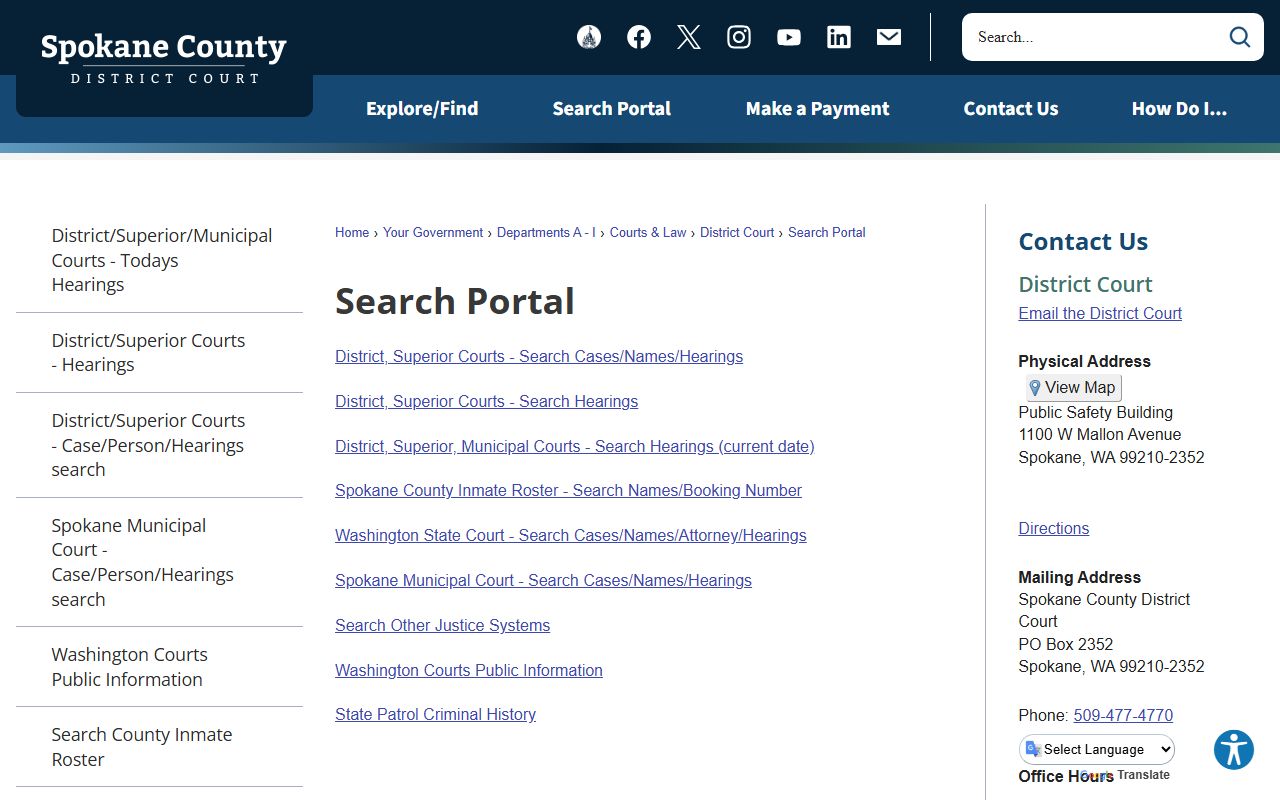
From that portal you can jump to a name search, a case-number search, or a hearing-date search without hunting through county menus.
- Open the Search Portal or the Court Viewer.
- Choose Superior Court or District Court for the case you want.
- Pick a search mode: case number, party name, or hearing date.
- Enter at least a last name and first initial for a name search, or the full case number if you have it.
- Review the result panels, then request a certified copy from the clerk if you need an official document.
Name searches return Name, Case Number, and date of birth. Case-number searches open case information, documents, and the hearing list. The county labels all of this reference material, not the official record.
The Spokane County Judicial System
Washington runs a four-level court structure, and Spokane County sits inside it. The Spokane County Superior Court is the general trial court. It is one of 39 Superior Courts in the state and has 13 judges elected to four-year terms, plus eight court commissioners. Below it, the District Court handles limited-jurisdiction cases. Appeals go to the Washington Court of Appeals, Division III, which is based in Spokane, and then to the Washington Supreme Court.
The Presiding Judge supervises court business and assigns cases. A Chief Criminal Judge runs felony arraignments and pretrial calendars. A Therapeutic Courts Judge oversees Drug Court, Felony Mental Health Court, and the Co-Occurring Disorders docket. Commissioners hear ex parte, domestic, juvenile, mental illness, and first-appearance matters, but they do not run jury trials.
The county Superior Court overview lays out these roles in plain terms.
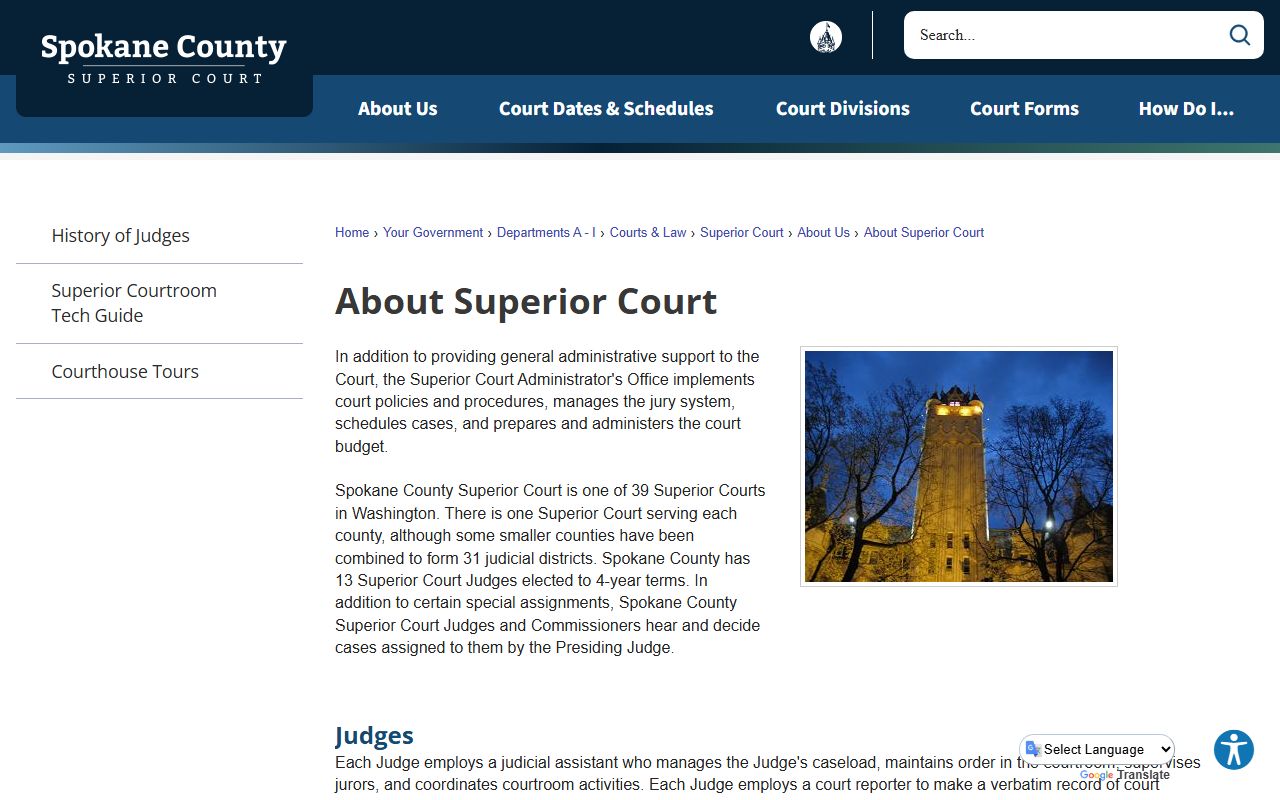
Each judge works with a judicial assistant, a court reporter, and a courtroom clerk who keeps the case journal.
Case flow: District / Municipal Court › Superior Court › Court of Appeals Division III › Washington Supreme Court
| Court | Jurisdiction | Case Types |
|---|---|---|
| Washington Supreme Court | Highest state court | Final appeals, state constitutional questions |
| Court of Appeals, Division III | Intermediate appeals | Appeals from Spokane County Superior Court |
| Superior Court | General jurisdiction | Felony, divorce, probate, guardianship, juvenile, major civil |
| District Court | Limited jurisdiction | Misdemeanors, traffic, small claims, name changes, protection orders |
| Municipal Court | City jurisdiction | City code and ordinance cases |
For the full judge roster, addresses, and direct phone lines, the Washington Courts directory for Spokane County stays current. More detail sits on the Spokane County Superior Court page.
Spokane County Courthouses
The county does not run everything from one lobby. The historic Spokane County Courthouse at 1116 West Broadway Avenue holds the Superior Court and the Clerk's Office. The District Court and many criminal calendars sit in the Public Safety Building at 1100 West Mallon Avenue. Knowing the right building saves a wasted trip, because filing a Superior Court case and paying a District Court ticket happen at different doors.
The county contact pages list each office address and phone line. The Superior Court contact page is one good starting point.
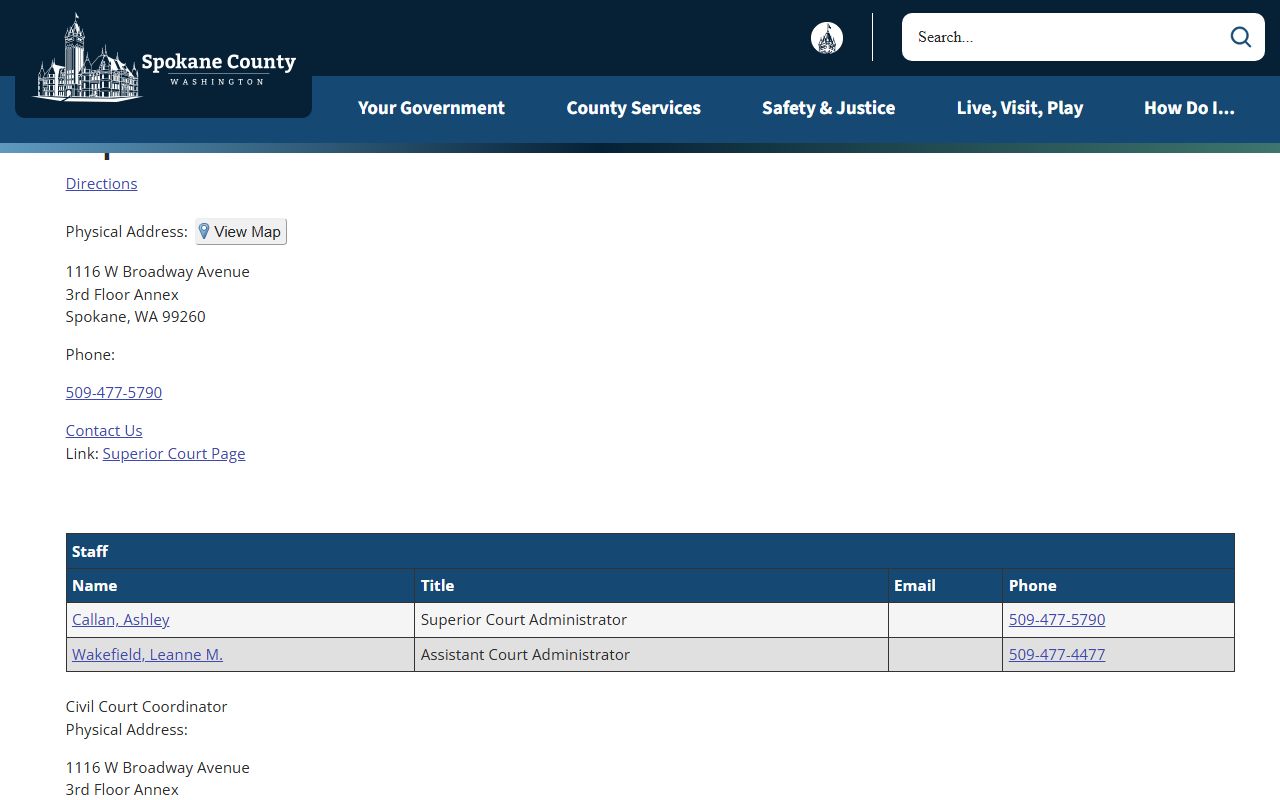
The three cards below cover the offices most records seekers need.
Spokane County Superior Court
1116 W Broadway Ave, 3rd Floor Annex
Spokane, WA 99260
509-477-5790
Clerk of the Superior Court
1116 W Broadway Ave, Room 300
Spokane, WA 99260
509-477-2211
Spokane County District Court
Public Safety Building, 1100 W Mallon Ave
Spokane, WA 99260
509-477-4770
Types of Court Records Available in Spokane County
Spokane County court records cover a wide range of case types. The court that handles a case decides where its records live. Superior Court keeps felony, family, probate, and major civil files. District Court keeps misdemeanor, traffic, small claims, and protection-order files. Some records are open to anyone, and some are limited by statute or court rule.
The District Court alone reports more than 46,000 cases filed in an average year. The county District Court page shows the case types and the records tools it offers.
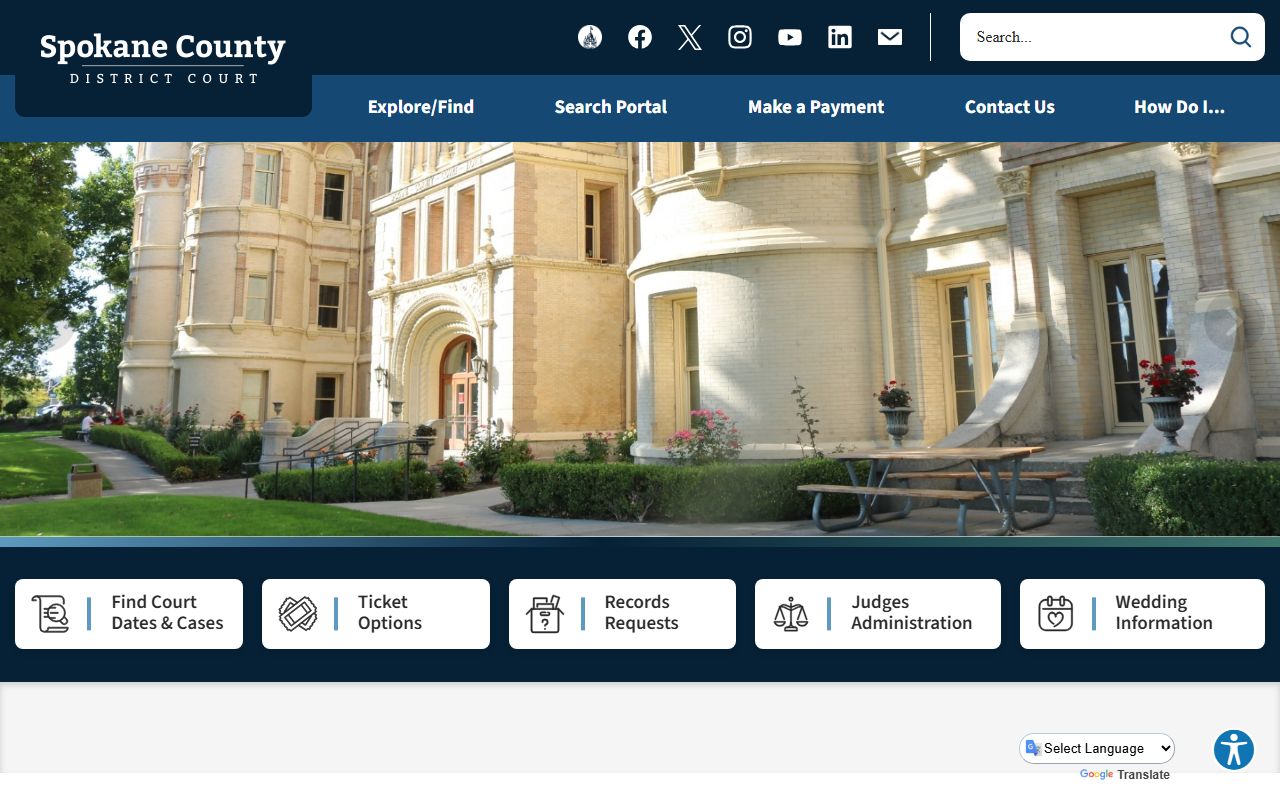
The list below sorts the main record types by the court that holds them.
- Criminal records - felony files in Superior Court; misdemeanor and gross-misdemeanor files in District Court. See arrest records.
- Civil records - lawsuits, judgments, garnishments, and liens, split between the two trial courts by dollar amount.
- Family and divorce records - dissolution, custody, support, and parentage in Superior Court. See marriage and divorce records.
- Probate records - estates, wills, and guardianships in Superior Court. See probate records.
- Traffic records - infractions and citations processed by District Court.
What Spokane County Court Records Show
A Spokane County court record holds the facts of a case from filing to disposition. The Court Viewer shows a case information panel, a documents panel, and a hearings list. Name searches return the party name, the case number, and a date of birth. The fields below appear across most case types, though some are blank until a case moves forward.
| Field | What It Shows |
|---|---|
| Case Number | The court's file number; Superior Court uses numeric formats, District Court uses alphanumeric ones. |
| Filing Date | When the case opened with the court. |
| Parties | Plaintiff, petitioner, defendant, or respondent names. |
| Charges / Cause | The crime charged or the legal basis of a civil claim. |
| Disposition | The outcome, such as a plea, judgment, or dismissal. |
| Sentence / Judgment | The penalty or money award the court ordered. |
The county warns that Superior Court documents filed before January 2005 are not online. Those older files can be viewed in person or requested from the clerk. For a deeper field-by-field look, the Spokane County court records page breaks down every panel.
Public Access Laws for Spokane County Court Records
Washington splits agency records from court case records. The Public Records Act covers most county agency files, while court rules cover case files. That is why the county says court records cannot be pulled through its online public records portal and must come from the right court clerk. The key authorities are below in plain English.
Key Statutes and Rules:
Washington Code § 42.56 - the Public Records Act; agency records are open unless a clear exemption applies.
General Rule 31 - sets public access to court case records, dockets, and orders.
General Rule 22 - limits access to sensitive family-law and guardianship documents.
Washington Code § 70.48.100 - keeps detailed jail records confidential beyond the public roster.
The county clerk's copy fees are set under Washington Code § 36.18.016. The public records page explains how the Public Records Act and court rules differ.
Records That Are Restricted or Confidential
Not every file is open. Juvenile, dependency, and "Becca" cases are restricted under Washington Code § 13.50, and the Superior Court hearing search says those court dates are not posted online. Adoption files are confidential under Washington Code § 26.33.330. Mental health and civil commitment records are limited under Chapter 71.05. Family-law files can have financial and medical pages sealed under GR 22.
To view a sealed record, a person usually files a motion in the court that holds the file, serves the other side, and asks a judge for an order. Sealed warrants and some protection-order details may also stay closed for safety. The clerk can tell you whether a file is open before you request copies.
Specialty Courts in Spokane County
Spokane County Superior Court runs Behavioral Health Adult Felony Therapeutic Courts. These include Drug Court, Felony Mental Health Court, and a Co-Occurring Disorders docket, all overseen by the Therapeutic Courts Judge. They are treatment-focused dockets for felony-level defendants, not ordinary criminal calendars.
The county campus map notes a Mental Health Therapeutic Court office in the Broadway Center Building, though those hearings are held in the Public Safety Building. District Court also publishes informational videos on therapeutic courts, defendant rights, and bench warrant recall. The county runs reentry and treatment programs at Geiger as well, which connect to the released inmates page.
Spokane County Sheriff and Jail
The Spokane County Sheriff's Office, led by Sheriff John Nowels, sits at 1100 West Mallon Avenue. Detention Services runs two facilities, the Spokane County Jail downtown and Geiger Corrections Center on Spotted Road, with a combined average daily population above 700. The live roster lists current inmates, recent bookings, and recent releases, and it shows each inmate's bond and custody status.
For the full roster fields, visitation rules, and money instructions, see Spokane County inmate records. To check whether a person has an active warrant, start with warrant records. Jail population data lives on the jail population page.
Marriage, Divorce, and Probate Records
The Spokane County Auditor issues marriage licenses, while the Clerk holds divorce files as Superior Court domestic records. Probate, wills, and guardianships are Superior Court matters kept by the same clerk. For full detail, see marriage and divorce records and probate records. A few common terms help when reading these files.
- Testator
- A person who leaves a valid will at death.
- Executor
- The personal representative named to settle an estate.
- Intestate
- Dying without a valid will, so state law decides who inherits.
- Guardian
- A person the court appoints to care for a minor or an adult who needs help.
Spokane County Court Records Fees
The Clerk of the Superior Court charges set fees for copies. Plain copies run a quarter a page, and certified copies cost more because the clerk stamps and verifies them. The clerk does not take debit or credit cards for copy fees, so mail requests need a check or money order. Filing fees are separate and larger.
| Item | Amount |
|---|---|
| Non-certified copy per page | $0.25 |
| Microfilm copy per page | $0.50 |
| Certified copy, first page | $5.00 |
| Certified copy, each added page | $1.00 |
| CD of courtroom recording | $25.00 |
Full filing fees, such as the $290 civil filing fee effective July 2025, are listed on the Clerk fee schedule and on the Clerk of the Superior Court page.
How to Interpret Spokane County Court Records
Court files use shorthand. "SC" means Superior Court and "DC" means District Court. A "disposition" is the outcome of a charge or case. "Dismissed with prejudice" means the case is closed for good, while "without prejudice" leaves the door open to refile. An arrest or charge is not a conviction; only a judgment or guilty plea settles guilt.
On the jail roster, "EHM" marks Electronic Home Monitoring, which means the person is supervised in the community and not held in a Detention Services building. When a record looks unclear, the clerk or the court of record can confirm what a code means.
Accuracy and Record Limitations
Online court data is a reference copy, not the official record. The county states plainly that it does not warrant the data is accurate, complete, or current, and that the court of record holds the official file. Data can lag, names can match more than one person, and older Superior Court documents from before 2005 are not online at all.
Note: Confirm any case detail with the Clerk's Office or the court of record before you rely on it for a legal, work, or housing decision.
History of Spokane County Courts
The county broke ground on its courthouse in the fall of 1893, during a national financial panic, and the project helped a struggling local economy. Officials moved in by November 20, 1895. The county calls the building a "castle," and its French Renaissance design draws from chateaux in France's Loire Valley, with towers, turrets, and detailed brickwork from a local Spokane maker.
That courthouse still anchors the county campus, even as court functions have spread into annexes, the Public Safety Building, and the jail. The official courthouse history covers the design and construction in full.
Frequently Asked Questions
How do I search Spokane County court records online?
Use the official Spokane County Search Portal or Court Viewer. Choose Superior Court or District Court, then search by case number, name, or hearing date. Name searches need at least a last name and first initial. The data is reference material, and official records stay with the court of record.
Can I get court records through the county GovQA portal?
No, not for court case records. The county's Court Records page says case records cannot be obtained through the online public records portal. Superior Court filed documents come from the County Clerk, and District Court documents come from the District Court Clerk.
What is the difference between Superior Court and District Court?
Superior Court is the general trial court for felony, divorce, probate, guardianship, juvenile, and major civil cases. District Court is the limited court for misdemeanors, traffic, small claims, name changes, and protection orders. They keep separate records and search tools.
More on the Spokane County Court Records FAQ page.